Insta360 and Splatica partner to democratize 360-to-3D Gaussian Splatting
We are thrilled to announce a partnership with Insta360 to democratize 360-to-3D Gaussian Splatting — making high-fidelity, simulation-ready 3D scenes achievable from a single consumer 360° camera.
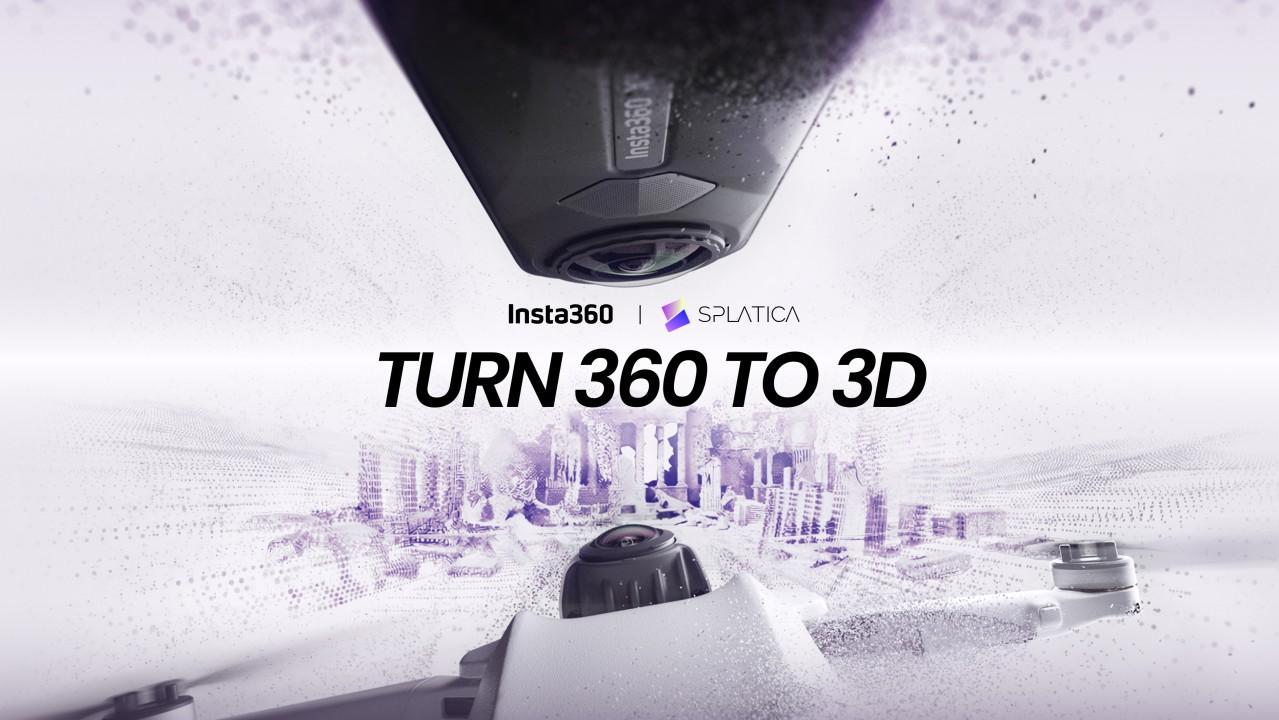
The challenge: bridging 2D capture to usable 3D
Creating usable 3D assets has traditionally been complex, time-consuming, and expensive. Multi-camera rigs, manual photogrammetry, and LiDAR setups often produce incomplete data, long processing times, and high technical barriers.
A typical manual 3DGS pipeline means extracting frames, running structure-from-motion (e.g. COLMAP), cleaning data, and training a model — usually requiring Python/CUDA expertise, powerful local GPUs, and hours or days of waiting. For developers working on digital twins, robotics, or physical AI, the gap between real-world capture and simulation-ready 3D has been a major bottleneck.
The first scalable 360° video → explorable 3DGS pipeline
With the Insta360 + Splatica pipeline, the workflow is dramatically simpler: capture a short 360° video, upload the file, and let the platform handle everything automatically. Within hours you get a high-fidelity, production-ready 3D Gaussian Splat — with real-time browser viewing, VR support, and exports to simulation environments like Isaac Sim and Omniverse. No manual preprocessing, no complex toolchains, no long training waits.
- Capture a short 360° video with an Insta360 camera (e.g. the X5) or the new Antigravity A1 drone.
- Upload the footage to Splatica.
- The platform automatically processes it into high-quality 3D Gaussian Splats, using full spherical coverage for superior completeness and visual fidelity.
Why it matters
This partnership fundamentally democratizes high-quality 3D Gaussian Splatting. By combining Insta360's affordable, consumer-grade 360° cameras and drones with Splatica's fully automated processing, anyone can capture a short 360° video and generate production-ready, photorealistic 3D scenes in minutes — without expensive LiDAR rigs, complex multi-camera setups, or manual post-processing.
A single 3–5 minute capture delivers a complete 3D scene with rich lighting, reflections, and geometric detail — fewer artifacts and higher fidelity than fragmented photo sets. That opens 3DGS and simulation-ready environments to a much wider audience, across:
- VR & entertainment — immersive, explorable environments for virtual production and location scouting.
- Manufacturing & digital twins — fast, accurate as-built models for facilities, training, and operations.
- Robotics & physical AI — diverse, photorealistic training data with extracted objects, semantic graphs, and embedded physics to help close the sim-to-real gap, with exports to Isaac Sim and Omniverse.
In their words
“With Splatica, a simple walkthrough with an Insta360 camera transforms into a photorealistic, simulation-ready 3D scene.” — Eugene Nikolskiy, CEO, Splatica
“360 capture is the most efficient foundation for next-generation 3D reconstruction.” — Yun Li, Insta360
What’s next
This collaboration is a significant step toward mainstream adoption of 3D Gaussian Splatting. Looking ahead, both teams are deepening the integration, expanding simulation features, and co-developing workflows — making the future of 3D reconstruction faster, simpler, and more powerful.